Current projects
Future Homes Standard 2026: delivery at scale
Purpose
To enable the new homes sector to deliver the Future Homes Standard (FHS) at scale, by bringing together homebuilders, Government and key partners to:
- Identify and implement viable technical solutions and specifications
- Address delivery challenges across supply chain, skills and infrastructure
- Ensure homes are delivered safely, cost-effectively and at high quality
- Put customers at the centre of the transition to low carbon living
The Future Homes Hub plays a central coordinating role, supporting industry and Government to ensure the Standard is successfully embedded across the sector.
Context
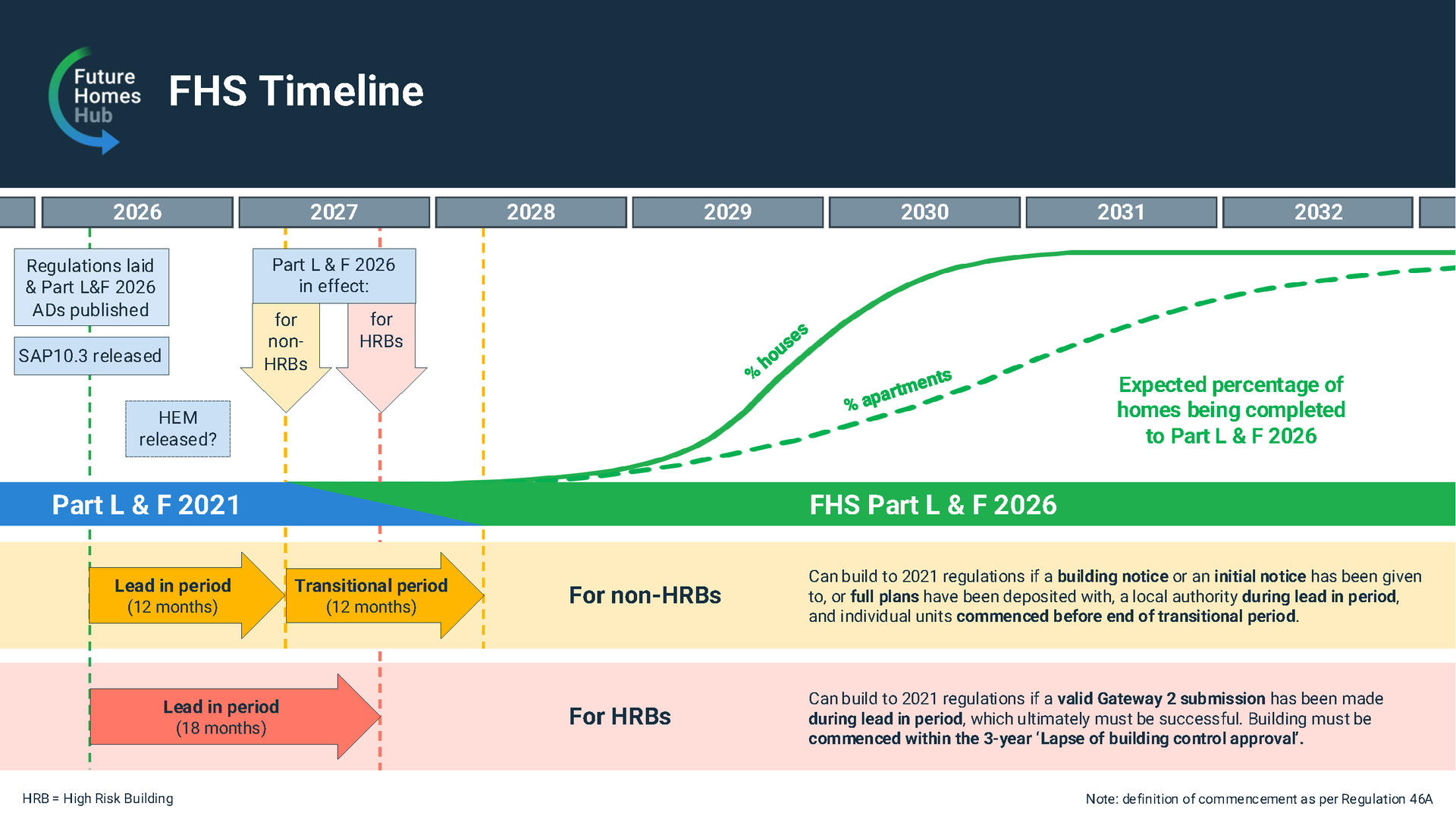
The Future Homes Standard consultation response was published in March 2026 amending Part L & Part F of the Building regulations. These new regulations will come into force during 2027 with a 12 month transitional period. (*)
The changes will improve energy efficiency and move away from gas boilers and other carbon-intensive heating. All new homes will then be 'zero carbon-ready', meaning that they will be zero carbon once the electricity grid has been decarbonised.
You can see an initial summary of the key changes in this video here.
The Standard requires:
- Deployment of low carbon heating systems (primarily heat pumps)
- High levels of fabric energy efficiency
- Integration of solar PV, mechanical ventilation and low carbon technologies
Delivering these homes at scale requires a coordinated, whole-system approach across design, construction, supply chains, infrastructure and customer experience.
The Future Homes Hub is uniquely placed to:
- Bring together industry and Government to support implementation
- Identify and resolve delivery challenges in real time
- Enable alignment across policy, regulation and market readiness
- Share learning and accelerate adoption of best practice across the sector
(*) See the links in the following section for more details on the transitional criteria and specific timelines for High Risk Buildings (HRBs).
The Future Homes Standard has been published with key documents available via;
• The Future Homes and Buildings Standards: impact assessments
• New Approved Document F (2026)
• New Approved Document L (2026)
• Design and construct new builds to enable smart meter installations
• Home Energy Model: Future Homes Standard Assessment Consultation response
Timescales and Approach
With Part L & F 2026 published and the associated transitional arrangements, the focus has shifted from policy development to implementation and continuous improvement:
- Pre-2026: Industry engagement, consultation support and testing of proposals
- 2026 onwards: Delivery of the Future Homes Standard at scale
- Ongoing: Refinement of guidance, tools and processes based on real-world performance and feedback
The following diagram provides a high-level overview of the Hub’s assumed timeline for the transition from Part L 2021 to Part L 2026 homes being delivered.
The Hub will continue to:
- Convene industry and Government to address emerging challenges
- Develop practical tools and guidance to support delivery
- Provide evidence and insight to inform ongoing policy evolution
- Facilitate collaboration to ensure consistent, high-quality outcomes
Planned Projects and Outputs
1. Industry Coordination and Delivery
The Hub will continue to:
- Operate the Future Homes Standard Implementation Board, co-chaired with Government, to oversee delivery at scale
- Bring together developers, supply chain, utilities and regulators to identify, monitor and resolve key issues
- Provide ongoing feedback to Government to support refinement and effective implementation
2. Tackling Key Delivery Challenges
The Hub is leading coordinated workstreams focused on the critical areas required to deliver the Standard at scale:
Grid infrastructure
- Improving demand assumptions and connection sizing
- Addressing impacts of solar PV generation and export
Heat pumps and heating systems
- Identifying and addressing skills shortages
- Supporting deployment across different housing types, including higher density developments
Heat networks
- Ensuring alignment between emerging standards and real-world delivery timelines
Ventilation and Indoor Air Quality
- Encouraging a holistic approach to ventilation system design, procurement, installation and commissioning
- Working with industry to improve the competency of all roles across the ventilation supply chain
Fabric and construction quality
- Developing practical guidance and tools to help improve the consistent delivery of fabric that is built as designed.
Overheating compliance process
- Supporting industry and planners to simplify the Part O compliance process while maintaining performance outcomes
Solar PV
- Helping government and industry to codify the new PV Functional requirement process
- Proving insights to installation approaches, design integration and construction impacts
SAP 10.3 & Home Energy Model (HEM)
- Supporting consistent application and assessor capability
Customer experience
- Embedding best practice to ensure low energy fossil-fuel-free new homes are clearly marketed to customers and provide with sufficient support once they move in.
- Promoting consistent, intuitive controls and user interfaces
3. Tools, Guidance and Industry Support
To support immediate and ongoing delivery, the Hub is providing a comprehensive suite of tools and resources:
The “Get Future Homes Standard Ready” campaign (2026–2027), focused on the core requirements for successful delivery:
There is a growing selection of supporting information available via the Knowledge Centre under development including:
Technical guidance;
- Heat pump design, procurement, installation and commissioning
- Grid connections
- Fabric performance and detailing
- Ventilation and Indoor air quality
Customer-facing guidance to support sales and handover of low carbon homes
Case studies and lessons learned from early delivery
Upcoming outputs include:
- Future Homes Standard: Where to start for homebuilders
- Heat pump SAP assessment guidance
- Ventilation in new homes: where to start for homebuilders
- Thermal Junctions: Hints & tips for homebuilders
- Rental customer journey guidance for low carbon homes
4. Enabling Delivery at Scale
A key focus is ensuring the critical enablers for large-scale delivery are in place, including:
- Supply chain capacity and readiness
- Workforce skills and training for low carbon technologies
- Electricity network infrastructure and connections
- Clear pathways for technology deployment across different housing types
The Hub is working with Government and industry to forecast technology uptake and proactively address constraints.
5. Sharing Learning and Continuous Improvement
To accelerate sector-wide progress, the Hub is:
- Sharing learning from live projects, trials and demonstrators
- Publishing case studies and practical insights
- Running working groups, site visits and technical events
- Supporting a Future Homes Standard community of practice
This ensures that lessons learned from early implementation are rapidly embedded across the sector.