

Ventilation and Indoor Air Quality
Indoor air quality is an essential part of delivering high-quality homes.
As new homes become more energy efficient and airtight, ventilation becomes a critical building service. When it doesn’t work well, indoor pollutants rise, moisture builds, and condensation and mould risks increase. Poorly designed or commissioned systems can also feel intrusive or confusing to use, leading residents to switch them off — which could impact wellbeing, satisfaction and long‑term durability.
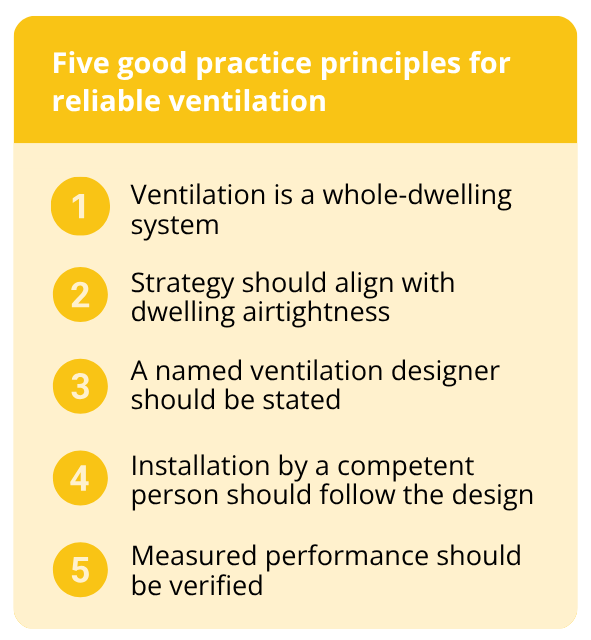
Effective ventilation is about far more than choosing products or meeting minimum airflow rates. It depends on how the whole system works in the dwelling: air supply and extract, transfer paths, controls, ductwork, terminals, commissioning and resident use. It must also be coordinated with airtightness, acoustics, fire safety, overheating, window design, services distribution and the wider building fabric.
For that reason, ventilation should be approached with the same discipline as structure, fire safety, fabric performance and heating. It requires clear design responsibility, coordinated delivery and meaningful verification, all aligned with the intended airtightness strategy and overall building design.
This guide supports homebuilders and project teams in delivering good ventilation outcomes in real homes. It explains the practical decisions, responsibilities and coordination steps that determine whether the strategy agreed at design stage is actually achieved on site.
It is aimed at those involved in briefing, design, procurement, construction, commissioning, inspection and handover — as well as clients, principal designers, specialist ventilation designers, manufacturers, installers and building control bodies. It is non‑statutory and does not replace Building Regulations, Approved Document F or detailed design work by competent specialists. It is developed to complement more technical installation and commissioning guidance contained in the Domestic Ventilation Installation and Commissioning Compliance Code of Practice, 2026 Edition (BEAMA/FETA).
The guide focuses on the practical actions that help make ventilation work in real homes — from early coordination and procurement through to installation quality, commissioning, handover and learning from completed projects.
Placing competency at the core of your process
Delivering successful ventilation in new homes requires individuals, from design, installation, commissioning and verification to be appropriately trained, skilled and competent. You can find more details the responsibilities associated with each of these roles, and how they should interact, in the guide.
Competence of the responsible ventilation designer
A ventilation design should be undertaken by a competent individual, supported by an organisation with appropriate quality management and accountability.
Depending on the system type and procurement route, the responsible designer may be:
- A specialist building services engineer
- A specialist ventilation contractor providing a design-and-install service
- An in-house design team with appropriate technical competence
- A ventilation equipment manufacturer offering a fully coordinated design service
Membership of a recognised competent person scheme may provide additional assurance where design competence is included within its scope. Other routes to demonstrating competence may be appropriate, provided equivalent assurance can be evidenced.
Competence from design to procurement
The procurement route determines who holds design responsibility in practice.
Where ventilation design is being undertaken by:
- An installer
- A specialist subcontractor
- A manufacturer
- An in-house team
Homebuilders should confirm that the individual or organisation responsible for design has appropriate competence and that this responsibility is clearly defined in contractual documentation.
Ventilation design responsibility is often assumed rather than explicitly defined and documented. In smaller schemes, the installer may effectively “design on the day”, based on experience rather than documented calculations.
Where the installer is undertaking the design, procurement should require evidence of competence in ventilation design, not just installation. Where design is retained by the homebuilder or a specialist, responsibility should be clearly named and recorded, including on the ventilation checklist.
Competent installation and commissioning
Installation and commissioning should be undertaken by suitably competent individuals operating within a recognised competent person framework. As Part F requirements tighten around system resistance and measured performance, competence becomes increasingly important.
Commissioning should not be treated as an administrative exercise. Measured airflows should be used to confirm that the whole dwelling ventilation rate has been achieved, not simply that individual wet room extract targets have been met.
Procurement documentation should therefore:
- Require commissioning against defined design airflow rates
- Require production of a valid ventilation commissioning checklist
- Ensure that ventilation-specific design information is made available to the installer on site
The value of independent verification
Independent verification introduces a credible likelihood that inadequate design, installation or commissioning will be identified. This reinforces good practice, supports competent practitioners, and builds confidence that systems are delivering the indoor air quality outcomes they were designed to achieve. Verification complements commissioning and does not replace it; it provides additional assurance that reported performance reflects the installed system.
A representative sample of completed dwellings, randomly selected, should be subject to independent third-party verification. The sample size should relate to the training and competence level of the installer and commissioner. Verification rates should therefore reflect:
Installers or commissioners operating within a recognised competent person scheme.
- Where auditing and competency oversight arrangements are already in place, an indicative verification rate of around 10% of installations may be appropriate.
Installers or commissioners operating outside a competent person scheme.
- Where no equivalent oversight exists, a higher verification rate, for example greater than 30% of installations, reflects the increased risk and provides a meaningful likelihood of review.
These rates are indicative and may be adapted to reflect system type, dwelling complexity and project-specific risk. This approach recognises existing quality assurance mechanisms while ensuring that all systems
Ventilation Competent Person Schemes & training
Membership of a recognised competent person scheme may provide additional assurance where design competence is included within its scope. Other routes to demonstrating competence may be appropriate, provided equivalent assurance can be evidenced.
There is a selection of Competent Persons Schemes & independent training course already in operation, each covering different stages of the ventilation delivery process.
| Provider | System types | Design | Installation | Commission | Verification | More info |
|---|---|---|---|---|---|---|
| Elmhurst Ventilation Competency Scheme | Int. Extract, dMEV, cMEV, MVHR | ✓ | ✓ | Link | ||
| NICEIC Mechanical Ventilation CPS | Int. Extract, dMEV, cMEV, MVHR | ✓ | ✓ | Link | ||
| NAPIT – Ventilation CPS | Int. Extract, dMEV, cMEV, MVHR | ✓ | Link | |||
| BESCA – Mechanical Ventilation CPS | Int. Extract, dMEV, cMEV, MVHR | ✓ | ✓ | Link | ||
| ATTMA – Domestic Ventilation Commissioning Certification Scheme | Int. Extract, dMEV, cMEV, MVHR | ✓ | Link | |||
| NAPIT - BPEC Domestic Ventilation | Int. Extract, dMEV, cMEV, MVHR | ✓ | ✓ | Link | ||
| NICEIC Domestic Ventilation | Int. Extract, dMEV, cMEV, MVHR | ✓ | ✓ | Link | ||
| BSRIA – Domestic ventilation (High-level CPD) | Int. Extract, dMEV, cMEV, MVHR | ✓ | ✓ | ✓ | Link | |
| The Building Performance Hub (ATTMA) | Int. Extract, dMEV, cMEV, MVHR | ✓ | Link | |||
| Property Care Association | Int. Extract, dMEV, cMEV, MVHR | ✓ | ✓ | ✓ | Link |